Mechanisms, Capacities, and Dependencies
Funded by a Reinhart Koselleck Project by the German Research Foundation (DFG), we’re developing and testing novel theories of causal learning and reasoning.
Causal cognition endows humans with impressive abilities. It allows us to predict and explain, plan actions, understand confoundings, make educated guesses about transfer situations, think about counterfactual alternatives, and use and engineer innovative devices. Our goal in this project is to better understand and explain the breadth and flexibility of causal cognition. Read the full project description.
Mechanisms
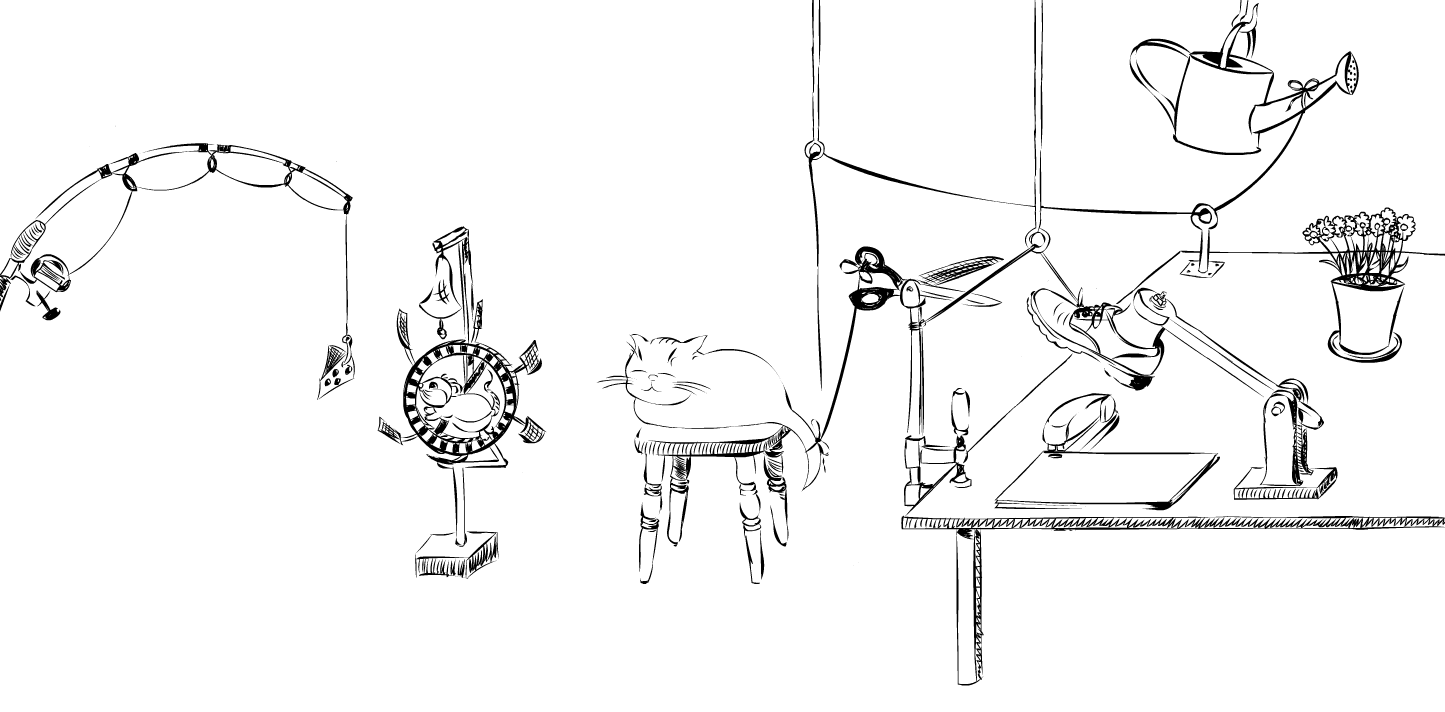
How do people represent the mechanisms that underlie causal relations, and how does this background knowledge guide their causal inferences?
Capacities
How do people reason about the capacities of the components that make up causal devices, such as a pendulum, a car, or a robot?
Dependencies
How do people learn and use dependencies between variables, as captured by causal Bayes nets and structural causal models?
People




Iria Gonzalez Quiroga
Research Assistant (Leipzig)
Ronja Riege
Student Assistant
Collaborators
Daniel Hanus
Department of Comparative Cultural Psychology, Max Planck Institute for Evolutionary Anthropology, Leipzig
Studies with great apes
Hannes Rakoczy
Department of Cognitive Developmental Psychology, University of Göttingen
Studies with children

Project Publications
Placì, S., Pighin, S., Mastropasqua, T., & Tentori, K. (2026). The development of probabilistic reasoning during early childhood. Cognition, 266, 106283.PDF GitHub
Stephan, S., Placì, S., & Waldmann, M. R. (2026). Recognizing estimation-relevant structural differences in predictive causal reasoning. In Proceedings of the 48th Annual Meeting of the Cognitive Science Society (Vol. 48).PDF
Stephan, S., & Waldmann, M. R. (2026). Manipulating causal priors affects the outcome-density bias. In Proceedings of the 48th Annual Meeting of the Cognitive Science Society (Vol. 48).PDF
Stephan, S., & Waldmann, M. R. (2026). Manipulating prior causal beliefs affects the formation of apparent causal illusions. Cognition, 277, 106684.PDF GitHub OSF
Wysocki, T. (2026). The underdeterministic framework. The British Journal for the Philosophy of Science, 77, 245–270.PDF
Gasalla, P., Figueroa, J., Waldmann, M. R., & Dwyer, D. M. (2025). Beyond the information (not) given: Associative mechanisms vs representations of uncertainty in extinction in laboratory rats (Rattus norvegicus). Journal of Comparative Psychology, 139(1), 69–79.PDF
Stephan, S. (2025). Reasoning about actual causation in reversible and irreversible causal structures. Journal of Experimental Psychology: Learning, Memory, and Cognition, 51(1), 152–169.PDF GitHub OSF PreReg2024 Best Paper Award by Division 3 of the APA.

Marulanda-Hernández, J. C., Wiegmann, A., & Waldmann, M. R. (2024). Camouflaged liability: How the distinction between civilians and soldiers influences moral judgement of permissible harm in war. European Journal of Social Psychology, 54, 1168–1181.PDF
Stephan, S. (2023). Revisiting the narrow latent scope bias in explanatory reasoning. Cognition, 241, 105630.PDF GitHub OSFPrePrint
Stephan, S., Engelmann, N., & Waldmann, M. R. (2023). The perceived dilution of causal strength. Cognitive Psychology, 140, 101540.PDF GitHub OSF
Wysocki, T. (2023). An event algebra for causal counterfactuals. Philosophical Studies, 180, 3533–3565.PDF
Wysocki, T. (2023). Conjoined cases. Synthese, 201, 197.PDF
Recent Talks and Conference Presentations
Flash talk by Simon Stephan: “Manipulating Causal Priors Affects the Outcome-Density Bias”
Flash talk by Simon Stephan: “Recognizing Estimation-Relevant Structural Differences in Predictive Causal Reasoning”
Talk by Michael Waldmann: “Interpolating causal mechanisms. The paradox of knowing more”
Talk by Simon Stephan: “Reasoning about Actual Causation in Reversible and Irreversible Causal Structures”
Talk by Tomasz Wysocki: “Polymorphic Functions for a Better Semantics of Counterfactuals”